Why Bigger Is Not Just More: The Mathematics Connecting Elephants, Heartbeats, and Cities
What is the correct dose of a drug for an elephant? The instinctive answer is surprisingly dangerous: take the dose used for a smaller animal and multiply it by the difference in body mass. A thousand-times-heavier animal receives a thousand-times-larger dose. The logic feels natural, and the conclusion can be catastrophically wrong.
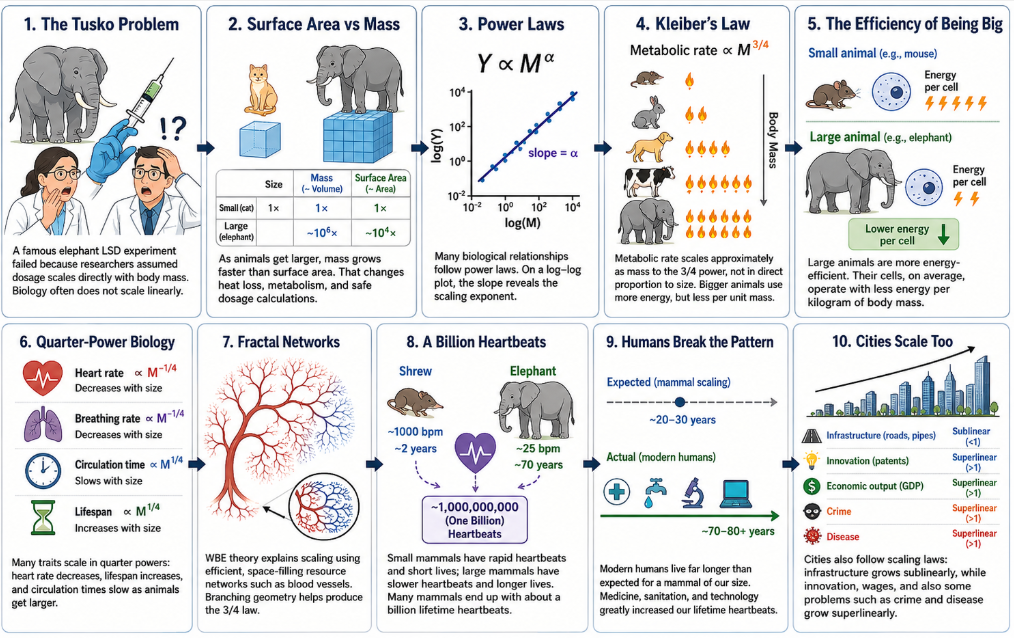
In 1962, researchers administered 297 milligrams of LSD to Tusko, a male Asian elephant. Within minutes, he collapsed and entered severe seizures; he later died after emergency treatment. The medical story is complicated, but the experiment remains a brutal reminder of a broader mathematical fact: large systems are not simply small systems multiplied by a constant.
The Comfortable Mistake of Linear Thinking
We usually begin with proportional reasoning: twice as many machines should produce twice as much work. In mathematical terms, we assume that an output $Y$ grows directly with size $M$:
$Y \propto M$
This is linear scaling: an exponent of one. Yet biology is shaped by surface area, volume, transport distance, branching networks, and resource exchange. Each mechanism changes at a different rate as an organism grows.
If an animal becomes ten times longer while keeping roughly the same shape, its surface area grows by $10^2=100$, but its mass grows by $10^3=1000$. The larger animal has less surface area per kilogram. A mouse therefore loses heat rapidly, while an elephant must remove heat from a huge body.
Power Laws: The Mathematics Behind “Not Proportional”
The natural language of scaling is the power law:
$Y = cM^{\alpha}$
Here, $c$ is a constant and $\alpha$ is the scaling exponent. When $\alpha=1$, size and output grow proportionally. When $\alpha<1$, the relationship is sublinear: the output grows, but more slowly than size. When $\alpha>1$, it is superlinear: the output grows faster than size.
On a log-log plot, a power law becomes a straight line whose slope is $\alpha$. Measurements from many species can therefore reveal a common rule hidden by the raw numbers.
Kleiber’s Law and the Efficiency of Being Big
In 1932, Max Kleiber compared body mass with metabolic rate and found that metabolism appeared to scale approximately as mass raised to the three-quarter power:
$B \propto M^{3/4}$
This result, now called Kleiber’s law, says that a larger animal consumes more energy overall, but less per unit of mass. A 1,000-fold increase in mass predicts only $1000^{3/4}\approx178$ times the metabolic rate, rather than 1,000 times.
Divide metabolism by mass and the efficiency becomes visible:
$\frac{B}{M} \propto M^{-1/4}$
As body size increases, metabolic demand per kilogram decreases. In a useful but slightly simplified sense, every gram of elephant is cheaper to operate than every gram of mouse. This is the biological economy of scale.
The Network Hidden Inside the Body
Geometry alone predicts an exponent of $2/3$, because surface area grows as length squared while volume grows as length cubed. So where might the famous $3/4$ come from?
In 1997, Geoffrey West, James Brown, and Brian Enquist proposed an influential explanation based on the body’s transport networks. Blood vessels, airways, and plant vascular systems must fill space, reach every active unit, and move resources without wasting too much energy. Their model assumes a branching, approximately self-similar network whose terminal units, such as capillaries, remain similar in size across organisms. From these assumptions, the quarter-power family of scaling laws emerges.
The intuition resembles a delivery network. Instead of building a separate route from the warehouse to every house, traffic shares main roads and branches near its destination. Arteries, smaller vessels, and capillaries form the body’s equivalent distribution architecture.
Why a Mouse and an Elephant “Spend” Similar Heartbeats
Once metabolism scales sublinearly, several other patterns become easier to understand. Mammalian heart rate is often approximated as scaling with $M^{-1/4}$, while lifespan scales approximately with $M^{1/4}$. Small mammals have rapid heartbeats and short lives; large mammals run more slowly and tend to live longer.
Multiply heart rate by lifespan and the mass terms cancel:
$M^{-1/4}\times M^{1/4}=M^0=1$
This produces the memorable observation that many mammals experience roughly the same order of magnitude of lifetime heartbeats—often close to one billion. It is not a biological stopwatch and there are important exceptions, but it captures something profound: animals can spend their biological budget quickly or slowly.
Humans Changed the Biological Contract
Humans are a striking exception. Our resting heart rate is not extraordinarily slow for our size, yet modern people routinely live for many decades. Sanitation, vaccination, antibiotics, safer childbirth, and public-health infrastructure removed many causes of early death. Rather than rewriting every cell, we changed the environment surrounding the organism.
A scaling rule may suggest a biological trajectory, but social systems can move the outcome far from that baseline. Scaling laws describe constraints and averages—not destiny.
Cities: Organisms Made of People?
And here is where the story becomes even more interesting. Similar power laws appear in cities. Research by Luís Bettencourt, Geoffrey West, and colleagues found that urban infrastructure—such as roads, electrical cables, and fuel stations—often scales sublinearly with population. A city twice as large does not require twice as much infrastructure. With an exponent around $0.85$, doubling population requires roughly $2^{0.85}\approx1.8$ times the infrastructure.
However, socioeconomic activity often scales in the opposite direction. Wages, GDP, patents, and some measures of innovation have been reported to scale superlinearly, with exponents around $1.15$. Doubling population can then produce approximately $2^{1.15}\approx2.2$ times the output. Density allows infrastructure and knowledge to be shared while increasing possible human interactions.
Superlinear scaling is morally neutral. Crime and contagious disease can also increase faster than population. Cities amplify creativity and harmful interactions through the same network effect: scale multiplies activity without choosing its value.
The Important Scientific Caveat
The quarter-power story is elegant, but the exact metabolic exponent remains debated. Some datasets are closer to $2/3$, others to $3/4$, and the value may depend on species, size range, temperature, activity, and measurement method. The West-Brown-Enquist model is influential, not final.
This uncertainty does not destroy the central lesson. Researchers broadly agree that metabolism is usually sublinear, even if nature does not use one exponent everywhere. Urban scaling is likewise an average pattern, not a promise about every city.
The Real Lesson: Always Ask How It Scales
The elephant, mouse, human heart, and modern city point toward one practical rule: before multiplying a solution by size, identify the mechanism that changes. Is the system limited by area, volume, transport, heat, communication, or interaction density? Each answer produces a different exponent—and a different future.
Linear thinking is attractive because it is simple. Scaling thinking is powerful because it is closer to reality. Sometimes becoming larger creates efficiency. Sometimes it creates acceleration. Sometimes it creates a new failure mode that did not exist at the smaller scale.
Size does not merely change how much of a system we have. It can change the rules by which the system operates.
References
West, L. J., Pierce, C. M., & Thomas, W. D. (1962). Lysergic Acid Diethylamide: Its Effects on a Male Asiatic Elephant. Science, 138(3545), 1100–1103.
Kleiber, M. (1932). Body Size and Metabolism. Hilgardia, 6(11), 315–353.
West, G. B., Brown, J. H., & Enquist, B. J. (1997). A General Model for the Origin of Allometric Scaling Laws in Biology. Science, 276(5309), 122–126.
Bettencourt, L. M. A., Lobo, J., Helbing, D., Kühnert, C., & West, G. B. (2007). Growth, Innovation, Scaling, and the Pace of Life in Cities. Proceedings of the National Academy of Sciences, 104(17), 7301–7306.
Glazier, D. S. (2023). How and Why Does Metabolism Scale with Body Mass? Physiology.