The math behind the Coronavirus spread
It is hard to avoid the news about the epidemic hitting the world in 2020 - the COVID-19 (also known as the Coronavirus). This is even harder because of our highly connected world which everyone is depending on so many industries and processes worldwide. Upon all of this, the fake news seeding panic in the heart of the people with titles promising the end of humanity. There is no room for error, this is not the time to take the subject in ease but panicking is not helping either. We need to understand the phenomena so we can act accordingly.
Epidemiology is the study of the distribution, patterns, and determinants of health and disease conditions in defined populations. The subject is influenced by biology, sociology, environmental studies, and others. In the last few decades, using mathematical modeling and computer simulations, researchers and governments were able to get meaningful insights and make better decisions. Such models provide a safe, relatively cheap, and controlled environment to analyze epidemic spreads and their influence on people's health.
How this is related to the Coronavirus? Well, some math - don't close the page, it is like a vaccine injection... short and if you close your eyes you will not feel it. (You probably should practice this experience, maybe we all need one really soon). The following equation represents a simple model (yet not very accurate) for the spreading of the Coronavirus in the population over time.
y(t) = a * e^(b*t)
An Israeli news website published a prediction using a model of this kind. Let me save you the details, I just will mention that on the 33rd day the model predicts 11B sick. As far as I can find, according to the United Nations Population Division, there are less than 8B people worldwide. Therefore, the only logical conclusion is that there are 3B aliens suffering from the Coronavirus somewhere.
A model that is already meaningful and yet very simple is the SIR model. The model works as follows: S(t) are those susceptible but not yet infected with the disease; I(t) is the number of infectious individuals; R(t) are those individuals who have recovered from the disease and now have immunity to it. Epidemic dynamics by the SIR model can be described as follows:
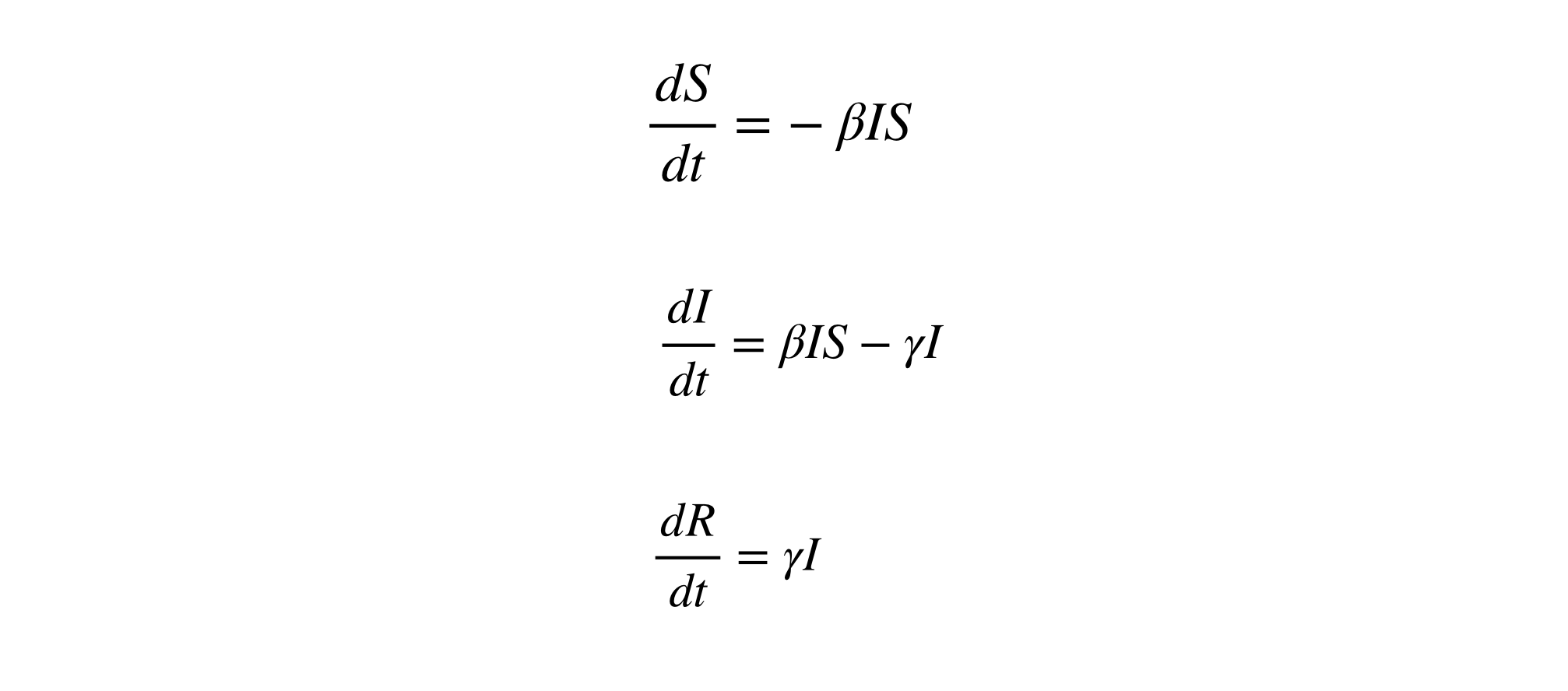
If you forgot many years ago how to read these equations - don't worry. Based on a model from the SIR models family and historical records of diseases biologically similar to the Coronavirus and the data of the first 28 days of the epidemic the model predicts 85K cases in china alone in the peak. Similar results are correlated to the population size.
As you continue to come across news coverage of COVID-19, take necessary precautions, but don’t panic! Remember, there are still many unknowns, and much of what is being announced today will likely change in the coming weeks as new data becomes available and governments taking active actions to handle the situation.
References
[1] El Mehdi Lotfi, Mehdi Maziane, Khalid Hattaf, Noura Yousfi. "Partial Differential Equations of an Epidemic Model with Spatial Diffusion", International Journal of Partial Differential Equations (2014)
[2] Milan Batista. "Estimation of the final size of the coronavirus epidemic by the SIR model" (2020).
[3] Niiler, Eric. “An AI Epidemiologist Sent the First Warnings of the Wuhan Virus.” WIRED (2020).
[4] F. Darabi Sahneh and C. Scoglio, "Epidemic spread in human networks," IEEE Conference on Decision and Control and European Control Conference, 2011.