When a Diploma Stops Being a Ticket In
Youth unemployment in the U.S. has been creeping up. Among workers aged 16–24, the unemployment rate was around 10.4% in September, and it is generally been trending upward since April 2023, when it hit its post-pandemic low. Historically, recent college grads were supposed to be among the “safest” workers in the economy. If you had a bachelor’s degree, you were more or less employable. That pattern is starting to break. For the first time in modern history, a bachelor’s degree is no longer a reliable path to professional employment. And the timing matters. Graduating into a weak labor market doesn’t just hurt in the moment; research shows it can leave scars that last for decades: lower earnings, slower career progression, less wealth accumulation. So what’s actually going on?
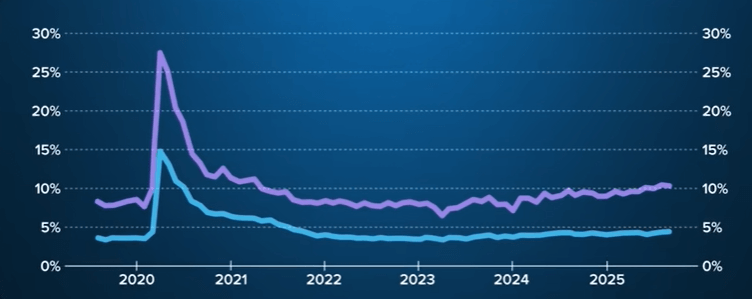
U.S. unemployment rates - taken from CNBC. Blue line indicates all ages over 16 while purple line indicates 16 to 24 years old.
The Glut of Degrees Meets a Cooling Economy
There are at least three overlapping dynamics: More degrees than ever, demand is not keeping up, and entry-level jobs are quietly disappearing. For the first part, the supply side is easy to describe: more young people are going to college than previous generations. The workforce is becoming more and more educated. That sounds good… until you realize that if the number of degree holders rises faster than the number of degree-requiring jobs, you get a glut. On the demand end, businesses are simply not hiring at the pace new grads need. Independent of AI, many companies are in a “slow or no hiring” mode, or actively doing layoffs. If firms aren’t bringing on new workers, it doesn’t matter how polished your resume is – there just aren’t enough seats. Finally, the roles that used to be the launchpad for graduates – junior analyst, junior developer, assistant this-or-that – are thinning out. Some of that is economic caution. Some is structural change. And a growing part of that story now has two letters: AI.
AI and the Vanishing Entry-Level
It is fashionable to blame AI for everything, but there is a real phenomenon here - hear me out (or read me out). From the perspective of a large company, the logic is straightforward: if you can invest in AI systems that: a) write decent first-draft code; b) generate reports; c) summarize documentation; d) draft marketing copy; then the number of junior workers you “need” goes down. Or at least, that is how many companies are seeing it.
Some executives are open about it: they are cutting in certain departments to free up resources to “invest in AI”. At the same time, AI systems that can do junior-level coding or content work have gotten good enough that they directly substitute for the lowest rung of the ladder. So we get this weird situation where Unemployment for young workers in highly AI-exposed jobs has dropped, meaning fewer of them are in those roles at all, and older workers in less exposed roles are relatively stable, partly because it is politically and operationally harder to lay off senior staff.
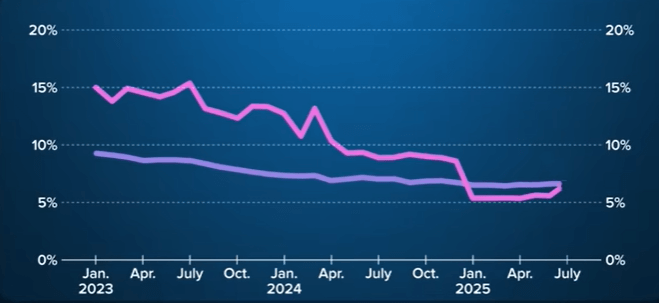
Percentage of employees between 21 and 25 in the US - taken from CNBC. Pink line indicates public companies while purple line indicates private companies.
From a business standpoint, it’s hard to argue with the incentives: AI doesn’t need health insurance, does not quit, and can work 24/7. From a new grad’s standpoint, it’s brutal. We spent years training for roles that are now either automated, consolidated, or redefined to require “2–3 years of experience with X” for what is still, effectively, an entry-level salary.
Not Just AI: The Long Shadow of Pandemic Hiring
It is tempting to blame AI alone, but the story is messier. During the COVID-19 pandemic, many companies – especially in tech – went on a massive hiring spree. For example, Amazon’s global workforce surged to around 1.6 million employees in 2021. By 2024, that number had dropped to about 1.5 million, and 2025 has continued the pattern of restructuring and layoffs, often framed as “preparing for the AI era.” Some argue this is just a delayed hangover from pandemic over-hiring: companies realized they expanded too fast and are now cutting back. Others push back: whatever “over-hiring” happened in 2020–2021 should largely have been corrected by 2023–2024. By late 2025, something else is going on. One underrated factor: labor scarcity taught companies how to do more with less. In 2021–2023, with tight labor markets, firms were forced to streamline processes, automate, and reduce dependency on headcount. Even if AI did not exist, learning to run leaner changed their default operating mode. Now add AI to that mix, and the result is a structurally different demand for junior workers.
The Shrinking Young Workforce
It is not just that young workers are struggling to get in. The young professional workforce itself is shrinking in some sectors. One compensation platform, Pave, found that between January 2023 and July 2025, the number of young workers at large public tech companies fell by more than half. Private tech companies have also seen declines. If you play this out over years, the implications get disturbing: Fewer young workers with stable jobs means less spending on housing, travel, and consumption. Similarly, Lower early-career earnings means smaller lifetime earnings, less saving, less investing. Thus, Lower tax contributions mean tighter government budgets or shifts in who bears the tax burden. Taken jointly, all of this means widening inequality and growing frustration with the economic system.
We are already seeing inequality trends move in the wrong direction. One analysis by Oxfam found that between 1989 and 2022, the top 1% in the U.S. gained roughly 100x more wealth than the median household. Layer youth unemployment on top of that and you don’t just have an economic story – you have a political one. Rising inequality and a generation feeling locked out of opportunity tends to show up later in elections, protests, and policy debates. At some point, the demand for income redistribution and structural reforms becomes hard to ignore.
So What Can Young Workers Actually Do?
None of this changes the macro reality: the current job market is genuinely hard for new grads. But the situation is not completely hopeless, and “just wait it out” is not the only strategy. There are two big levers that are still very much in our control: reat AI Like a Power Tool, Not a Threat and Stop Relying Only on the Front Door.
For the first one, you do not have to build models or write research papers on transformers to be “good with AI”. Instead, learn how to structure prompts clearly and iteratively, Use AI to draft, refine, and debug code or content – then critically evaluate the output. Critically, know when AI is likely to hallucinate or mislead you. Chain tools: for example, using one system for code generation, another for analysis, and your own judgment to stitch things together. The more fluent you become with AI systems, the more you can show employers concrete examples of value you have created (projects, tools, automations) and demonstrate that hiring you is not just “adding another person” but “bringing in someone who multiplies output with AI”. In a world where companies are being told to “do more with less”, being the person who can do that (ethically and reliably) is a strong argument for your seat at the table.
For the second strategy, the traditional pipeline looked like this: Apply online → wait → maybe get an interview. Not anymore, that pipeline is clogged. One thing career experts keep repeating, and which too many of us ignored during school, is the outsized importance of networking: a) internships (even unpaid or part-time) create people who can vouch for you; b) side projects, hackathons, and open-source contributions create visible proof of ability; and c) informational interviews and alumni outreach create weak ties that sometimes turn into job leads. When hiring slows, personal connections become a bigger differentiator. Do not get me wrong - it is not fair. It is not purely meritocratic. But it is very real. If you are graduating without internships or professional relationships, the unfortunate reality is that you are starting from behind – which just means you have to sprint harder now.
A Hard Landing, But Not a Doomed Generation
I am still optimistic, even if that optimism feels more cautious now. Yes, the job market is rough. Yes, AI is reshaping the bottom rung of the ladder in ways that hurt new grads first. Yes, inequality is widening, and some macro forces are far beyond any individual’s control. But difficult times also tend to produce more resilient, more adaptive cohorts. I do not think AI is going to replace “smart, creative people”. It is going to replace some of the rote parts of early-career work, which will feel painful in the short term but could, in the long run, push us toward more interesting, higher-leverage contributions.
For now, though, the reality is simple - the bachelor’s degree alone is no longer a ticket in, AI is both a gatekeeper and an amplifier, and relationships matter more than we want to admit. For the class of 2025 and beyond, the challenge is to turn what looks like a rough starting point into a surprisingly strong foundation – so that when the market does turn, you should be just fine.