Black Market Size Estimation Methods Are Stuck In The 90s
The non-observed economy (NOE) which also known as the “black market economy” (or "black market" for short), is defined as all economic activity where the resulting income evades the tax authorities and government supervision [1]. To be more specific, researchers usually focus on four main components of the NOE: illegal production, underground production, statistical underground, and informal sector production. This definition has been accepting by the Organisation for Economic Co-operation and Development(OECD) 20 years ago and used by governments all over the world [1]. The estimation of the NOE is widely considered an important task because the unreported economic activity from the NOE erodes the tax base, and is likely to lead to greater public debt and a decrease in the scope and quality of public services [2].
Indeed, estimating the size of the NOE and the processes influencing it is a daunting, well-known task [3]. Moreover, determining the influence of the different social and economic processes on the NOE size is an urgent issue for governments as it has a direct influence on the taxation policy, crime, and other activities managed and controlled by the government [4]. The current state-of-the-art method used to estimate the size of the NOE is the currency demand approach (CDA) [5] and the Multiple Indicators Multiple Causes (MIMIC) model [4].
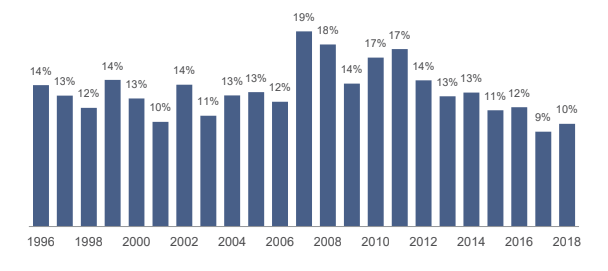
The share of the non-observed economy out of GDP in Israel
Source: Labib Shami, Taub Center, based on data from the Bank of Israel, CBS, and the OECD [2].
The leading method in computing the black market's size
In general, there are three main approaches to measuring the size of the NOE: the direct approach, the indirect approach, and the model approach. Each one of these has advantages and disadvantages and each leads to different results, even for the same country. However, when estimating the size of the NOE in one particular country, and since each country has its own methods of data gathering and data recording, the indirect approach has a clear advantage over the others based on its ability to use explanatory variables that are modified to each country.
However, it is safe to say that all three approaches built upon the currency demand approach (CDA), which was first suggested by Cagan in 1958 [5]. According to the CDA, the size of the NOE is measured in two stages. In the first, the aggregate demand equation for money (cash) is estimated econometrically with the inclusion of a specific parameter related to the use of cash in NOE transactions; in the second stage, the value of the NOE transactions are calculated using the quantity theory of money.
Here comes the assumption which was legitimate during the 1950s but no longer holds: In the first stage of the estimation, the main assumption is that all transactions in the NOE are carried out in cash to hide revenue and evade taxation. The aggregate demand for cash is estimated using variables that can be attributed to both the formal economy (such as the interest rate on deposits) and the NOE (such as the tax burden).
In the second stage, the share of the NOE within GDP is calculated by choosing a base year in which, according to the assumption, the contribution of the NOE to total GDP is equal to zero and the velocity of money is calculated according to the Fisher equation [6].
Technology has changed
The CDA is still relevant nowadays as cash is still used widely around the world. For example, in 2018, cash payments were 87 percent of all payments in Spain followed by Italy with 86 percent and Japan with 82 percent. Even in technological leading countries such as UK and USA have 42 and 32 percent, respectively. However, governments and banks starting to reduce the usages of cash thanks to the technological shifts in the banking and financial sphere.
These changes making the CDA less relevant by the day as criminals and the entire population transforms from cash to more technological payment methods. A wonderful example of this transformation is the cryptocurrency sphere which is growing by the day and already earns a reputation for criminal activities.
Cryptocurrency such as bitcoin, Ethereum, and, more recently, Monero has become the currency of choice for many drug dealers and extortionists. The criminal activities extend to tax evasion, money laundering, Ponzi schemes, and the theft of cryptocurrencies to kidnapping for ransom. As the demand for cryptocurrencies increases, it provides opportunities for criminals to hide behind the presumed privacy and anonymity. Identifying these cryptocurrency-related crimes have posed challenges for law enforcement due to the cross-border nature of transactions, the use of evasion technology to mask the identity of users, and inconsistent regulations [8].
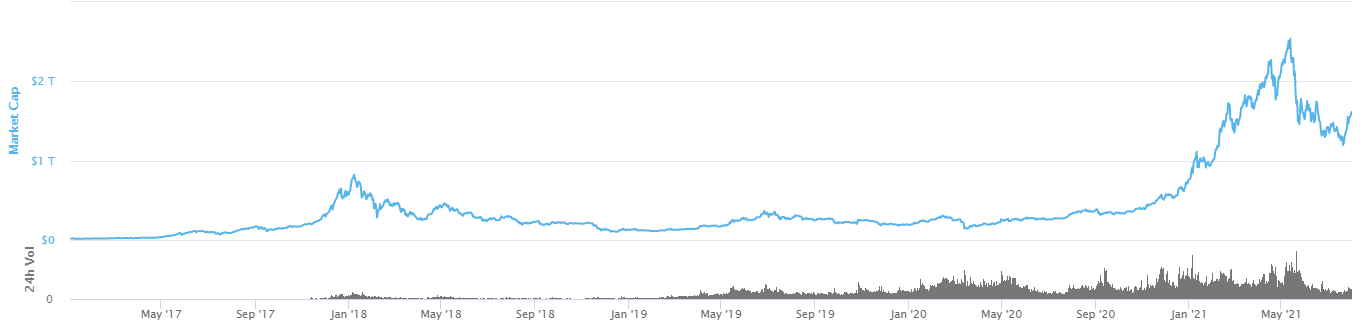
Total market cap of all cryptoassets, including stablecoins and tokens.
Source: Estimate of overall cryptocurrency market cap per week from July 2010 to June 2021 (statista.com) [8].
Main shortages
The changes in technology, advances in economic research, and integration of more sophisticated mathematical tools should lead black market researchers to questions a series of the assumption they so naturally assumed until now and may not be true legitimate anymore. We present a short, incomplete list of such assumptions: - which obtain multiple critics over the years, and sensitivity to the explaining variables (Shami, 2019).
- The assumption that the NOE is behaving similar (or identical) to the regular (white) market.
- The assumption that an initial size of the NOE is known.
- The assumption that the sensitivity of the NOE size on other observable economic processes is known or can be fairly linearly esstimated.
What we suggest?
In order to estimate the NOE size and better understand the different social and economic processes influencing it, including the role of currency demand, taxation, and cryptocurrency markets; one can take advantage of mathematical models and computer simulations.
We suggest developing a simulator for economic behavior, in which each individual is heterogeneous in the manner it has different target functions, possible economic actions, and social roles. While easy to say, such simulation would require huge computing power and data from multiple data sources originated in several disciplines. To keep things simple, imagine yourself a simulation of a small fishing village where individuals can perform economic transactions such as production (for example, catch fish), sell, buy, trade (one fish for ten potatoes), and pay taxes to the administration of the village. As part of these processes, individuals are able to decide to perform NOE-related activities to optimize their target functions. For example, if five percent of a daily catch should be provided to the administration of the village to be later distributed in the village. An individual can declare that s/he caught half of the real number and by that "pay" fewer taxes. We propose to handle such a decision-making task using deep reinforcement learning technology.
The outcome of such a simulator is the ability to investigate the emergence of an NOE. The careful reader would be able to notice that this approach overcomes the three main shortages we showcase. Indeed, this approach does not assume similar behavior, as no economic model is assumed - just a list of possible economic actions. Second, the initial size of the NOE is indeed known to be zero as our village just came to be. Finally, the sensitivity of the NOE size on other observable economic processes is not assumed or approximated but learned from the simulation's outcome.
References
- OECD (2000). Measuring the Non-Observed Economy - A Handbook. OECD.
- Shami, L. (2020). The non-observed economy in israel. TAUB Center.
- Gyomai, G., Arriola, C., Gamba, M., Guidetti, E. (2012). Summary of the OECD Survey onmeasuring the non-observed economy. Working Party on National Accounts, Paris: OECD.
- Enste, D., Schneider, F. (2002). The shadow economy: Theoretical approaches, empirical stud-ies, and political implications. Cambridge: Cambridge University Press.
- Cagan, P. (1958). The demand for currency relative to the total money supply. Journal of Political Economy, 66(4):303-328.
- Fisher, I. (1908). The Rate of Interest. The Economic Journal, 18(60):66-69.
- statista.com (2021). Estimate of overall cryptocurrency market cap per week from July 2010 to June 2021. Website.
- Jethineni S., Cao, Y. (2019). The Rise in Popularity of Cryptocurrency and Associated Criminal Activity. International Criminal Justice Review, 30(3):325-344.